Introduction
Recently, I developed an innovation plan to implement an in-class blended learning environment within my classroom. The result has been improved student engagement and performance. Witnessing my students’ growth has inspired me to create a professional learning (PL) plan that will help world language teachers within my School District to develop the skills that they need within a supportive environment so that their students, too, can benefit from an in-class blended learning experience.
There are currently twenty world language teachers between the Middle School and the High School who teach one or more of our language offerings – French, German, Latin, and Spanish. The World Language Department serves about two-thirds of the High School population, about 1300 students. Last year the High School implemented a one-to-one initiative with Chromebooks, and we will be providing Chromebooks to our Middle School students beginning next year. Given the new opportunities and challenges that increased access to technology brings, this is an ideal time to offer a professional learning experience to members of the World Language Department so that we can all make use of all the resources available to provide the most effective learning environment for our students.
Call to Action
Teaching students to prepare them for the Industrial Age is – thankfully – beginning to come to an end. Just as educators are developing new teaching and learning environments and methodologies to reflect what today’s students need from their education, it is time to reevaluate the professional learning experiences of teachers. Cookies cutter learning does not work for our students, and it does not work for out teachers either. To find out why I believe this, please view my Call to Action video.
Blueprint for Professional Learning
The professional learning experience that I have designed will be a yearlong process. Teachers will have the opportunity to learn new technology skills and to develop blended learning stations both independently and in groups. There is an option of continuing this professional learning experience into a second year for teachers who feel they need continued support.
The professional learning experience that I have designed for world language teachers makes use of the Four Disciplines of Execution to ensure that there is accountability. The activities in this professional development plan also draw from the Six Sources of Influence that will provide teachers with the support they need so that they want to do the work of implementing an in-class blended learning experience for their classes.
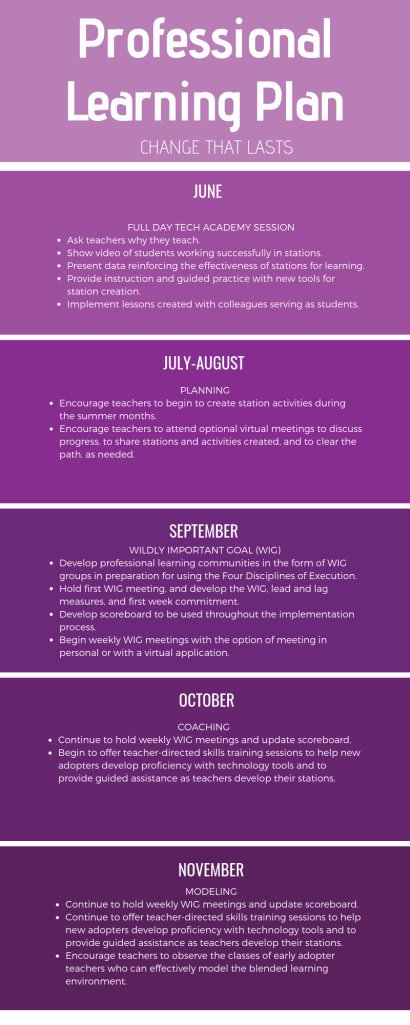
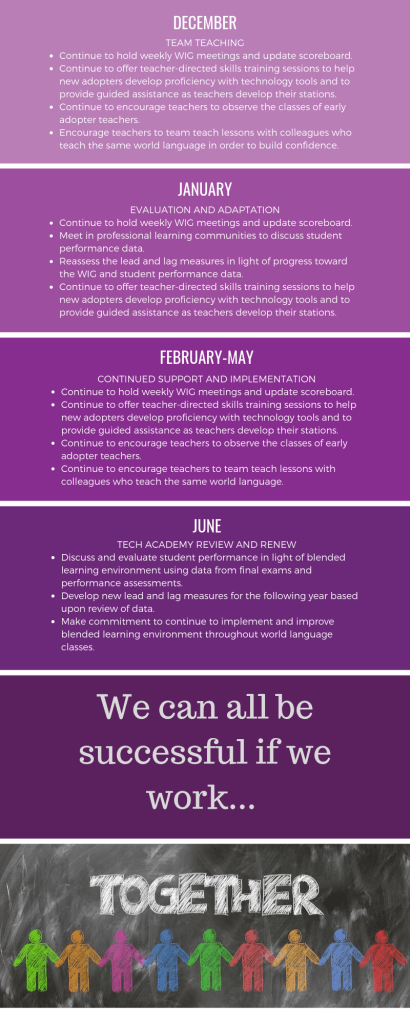
Plan Timeline
Audience
For the initial professional learning experience, the primary audience will be the teachers in the World Language Department at the Middle School and High School. The long term plan is for in-class blended learning to spread throughout the academic programs within the School District, and world language teachers who have successfully participated in the original professional learning experience will be able to serve as leaders and consultants for other departments.
Collaboration and Cooperation
Everyone will have a different starting point as the World Language Department begins our journey of implementing an in-class blended learning environment within our classrooms. Collaboration and cooperation will be essential if we are to be successful. Because of the unique pedagogy of world language instruction and learning, we will need to help each other to understand how technology tools can be used to enhance world language students’ learning experiences. Early adopters will be essential as they share the stations that they have already created and used and assist new adopters in the development of their own stations.
Self-directed Learning Experiences
Over the course of my twenty year teaching career, the majority of my professional learning experiences have been top down initiatives developed by building and district administrators. As Brenda Beatty reports in her article “Teachers leading their own professional growth: Self-directed reflection and collaboration and changes in perception of self and work in secondary school teachers,” self-directed professional learning experiences are often more effective:
“…transformation-inducing professional growth and development may most effectively originate, and thus be led, from within the individual teacher” (2000, p. 76)
Brenda Beatty
Beatty goes on to explain the correlation between teacher motivation and student achievement (2000, p. 78). Beatty’s research reveals that professional learning experiences are more effective when teachers have agency in the experience. Consequently, the professional learning program that I have developed is teacher-initiated and teacher-directed. The teacher coaches will provide the framework and the technology skills support to assist new adopters of in-class blended learning in their work to create and implement stations. However, professional learning meetings and the work created will be directed by the teachers who are actively engaged in the process.
Leadership
A colleague, who is a Lamar DLL graduate, and I will work together to facilitate professional learning communities and to lead WIG meetings as we use the Four Disciplines of Execution to set goals and make commitments that will lead to the successful implementation of in-class blended learning environments in our High School and Middle School world language classes. Early adopters will serve as coaches to assist new adopters.
Ultimately, one of our School District goals should be that teachers in every discipline make use of in-class blended learning environments to enrich student experience and to increase student performance. World language teachers who have successfully implemented blended learning in their classrooms can move into leadership roles to assist members of other academic departments who endeavor to establish the same environment for their students.
Five Principles of Effective Professional Learning
In her work Teaching the Teachers: Effective Professional Development in an Era of High Stakes Accountability, Allison Gulamhussein outlines five principles for professional learning:
- The duration of professional development must be significant and ongoing to allow time for teachers to learn a new strategy and grapple with the implementation problem. This professional learning experience will be ongoing over the course of a year. We will begin with a full day session at Tech Academy in early June. During that time we will discuss teachers’ “Why” statements, provide background research on the effectiveness of blended learning environments, provide an opportunity for technology skills development with teacher coaches, and allow teachers time to begin to create their own station activities. Weekly WIG (Wildly Important Goal) meetings will begin in September and continue throughout the course of the school year.
- There must be support for a teacher during the implementation stage that addresses the specific challenges of changing classroom practice. Beginning with the Tech Academy session in June, teachers will be supported by early adopters of blended learning stations within the World Language Department. The early adopters will provide advice and assistance based upon their personal experiences with blended learning. They will continue to be available throughout the school year as coaches.
- Teachers’ initial exposure to a concept should not be passive, but rather should engage teachers through varied approaches so they can participate actively in making sense of a new practice. When teachers attend the Tech Academy session that will serve as the launch of the blended learning PL program, they will be actively engaged in creating their own stations. During the afternoon, fellow teachers will experience their colleagues’ newly created stations firsthand and provide feedback to allow teachers to know what works well and how they can improve.
- Modeling has been found to be highly effective in helping teachers understand a new practice. Beginning in late October and continuing through November and December, new adopters will have the opportunity to observe the classes of world language teachers who are early adopters of the blended learning environment and to follow up with questions to seek clarification.
- The content presented to teachers shouldn’t be generic, but instead specific to the discipline (for middle and high school teachers) or grade-level (for elementary school teachers) (Gulamhussein, 2013). One of the more frustrating realities for many world language teachers is that professional learning experiences are rarely, if ever, specific to their discipline. By implementing this professional learning plan within the World Language Department, resources and strategies will relate specifically to our discipline.
Resources and Media
As teachers undertake this professional learning experience, our most valuable resource will be the expertise and experience of early adopters. They have the technology skills and the knowledge of what works and what does not work to pave the way for new adopters of this teaching and learning environment.
For the first launch meeting at Tech Academy in June, we will launch the professional learning program with a slide presentation, which includes some background information and a testimonial of the success of station rotation within a blended learning environment:
Significant time will be allocated to brainstorming during the initial presentation phase. Additionally, we will also offer some examples of station activities that early adopters have used.
Conclusion
The days of the industrial model of teaching and learning are over…or, at least, they should be. As educators look to the future through the eyes of their students, we need to ensure that we are providing them what they need to be successful. While it may be easier to continue to do what we have always done, that strategy will not serve our students as well as adopting a new mindset that will challenge us as teachers to reach our students in a new and more engaging way.
References
Beatty, B. R. (2000). Teachers leading their own professional growth: Self-directed reflection and collaboration and changes in perception of self and work in secondary school teachers. Journal of In-service Education, 26(1), 73-97. https://doi.org/10.1080/13674580000200102
Grenny, J., Patterson, K., Maxfield, D., McMillan, R., & Switzler, A. (2013).
Influencer: The new science of leading change (2nd ed.). New York: McGraw-Hill Education.
Gulamhussein, A. (2013, September). Teaching the teachers: Effective professional development an era of high stakes accountability. Retrieved from The Center for Public Education website: https://www.academia.edu/28440314/Teaching_Effective_Professional_Development_in_an_Era_of_High_Stakes_Accountability_READ_THE_REPORT_Center_for_Public_Education
McChesney, C., Covey, S., & Huling, J. (2016). The 4 disciplines of execution:
Achieving your wildly important goals. New York: Free Press.
McGraw-Hill PreK-12. (2016, April 19). Catlin Tucker talks about blended
learning with station rotation [Video file]. Retrieved from https://www.youtube.com/watch?time_continue=1&v=J80MQd60UZc
McGraw-Hill PreK-12. (2016, April 5). How and why to integrate station rotation
in your classroom [Video file]. Retrieved from https://www.youtube.com/watch?time_continue=2&v=oY5iXxqe_WU
Image source: pixabay.com
 Growing my Classroom